

Why Letting Go of Control Supports Nervous-System Healing
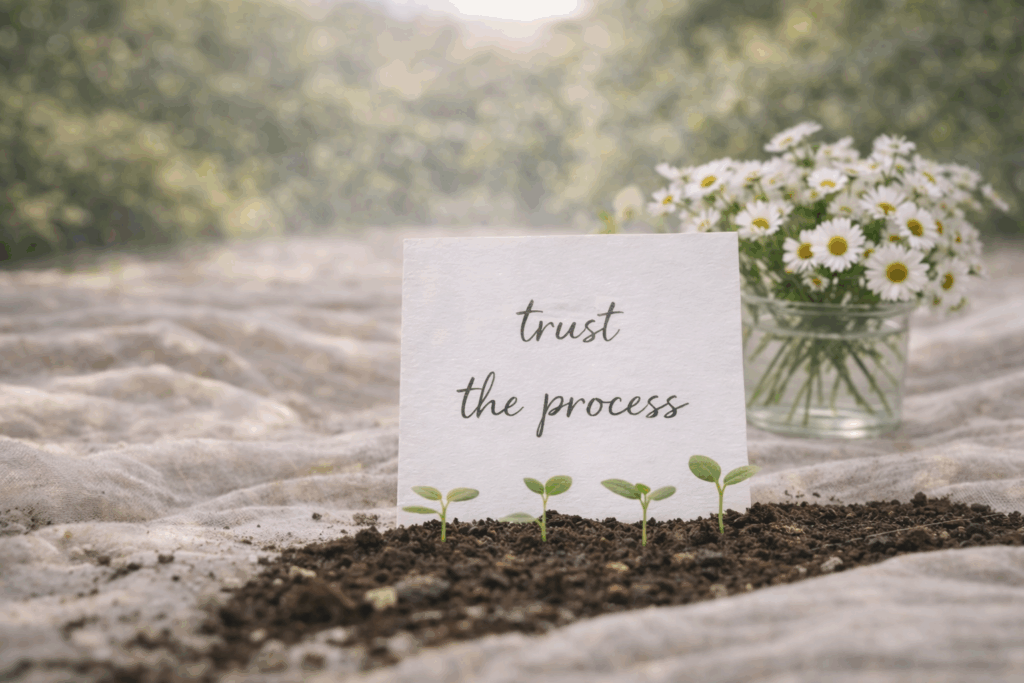
“Trust the process” is often offered as encouragement.
But for many people, it feels hollow — or even harmful — especially when control once kept them safe.
The guidepost Trust the Process invites a deeper, more grounded understanding of trust as a nervous-system capacity, not a belief system.
Why Control Develops
Control often forms in environments where:
- Unpredictability was dangerous
- Needs went unmet
- Responsibility fell too early
- Safety depended on vigilance
The nervous system learns to anticipate and manage outcomes.
Control is not a flaw.
It is a strategy.
Control and the Nervous System
Control keeps the nervous system in a state of readiness.
While useful in the short term, sustained control can lead to:
- Exhaustion
- Anxiety
- Hypervigilance
- Difficulty resting
- Fear of uncertainty
Trust allows the nervous system to downshift.
But trust only emerges when safety is present.
Trust vs. Passivity
It’s essential to distinguish these.
Passivity disconnects from agency.
Trust stays engaged — without micromanaging.
It might look like:
- Responding instead of anticipating
- Adjusting instead of forcing
- Allowing outcomes to unfold
- Staying present with uncertainty
Trust is active, not resigned.
When Trust Feels Impossible
There are seasons when trust feels inaccessible.
Grief.
Trauma.
Major transitions.
In these seasons, trust may look like:
- Trusting your next breath
- Trusting today, not the future
- Trusting your ability to adapt
- Trusting support when it’s offered

Trust doesn’t have to be global.
It can be momentary.
Trust in Relationships
Trust grows through consistency.
Through repair.
Through reliability.
And, through boundaries.
Letting go of control in relationships does not mean tolerating harm.
It means allowing space for mutual responsibility.
Trusting the Body
One of the most profound forms of trust is trusting the body.
Listening to cues.
Responding to fatigue.
Allowing rest.
The body often knows before the mind.
How to Practice Trust Gently
To work with this guidepost:
- Notice control without judging it
- Loosen one small grip
- Observe outcomes
- Anchor in the present
- Allow trust to be earned, not demanded

Trust grows through experience.
Integration: Letting Safety Lead
The guidepost “Trust the Process” reminds us that trust is not a leap.
It’s a gradual release.
You don’t have to surrender control everywhere.
You only need to notice where it’s no longer necessary.
Continue the Practice
If this guidepost resonated, you’re invited to continue exploring it at your own pace.
🎧 Listen to the companion podcast episode:
→ The PlayFULL Way — Trust the Process
(Available wherever you listen to podcasts)
📝 Download the reflection + journaling pages:
A gentle printable to help you pause, reflect, and integrate this week’s guidepost.
→ Subscribe & Request the Trust the Process Guide
💌 Receive the weekly companion letter:
A short note each week with reflections, prompts, and invitations to practice slowly and honestly.
→ Weekly Newsletter Subscription
There’s no right way to engage.
Take what supports you. Leave the rest.